


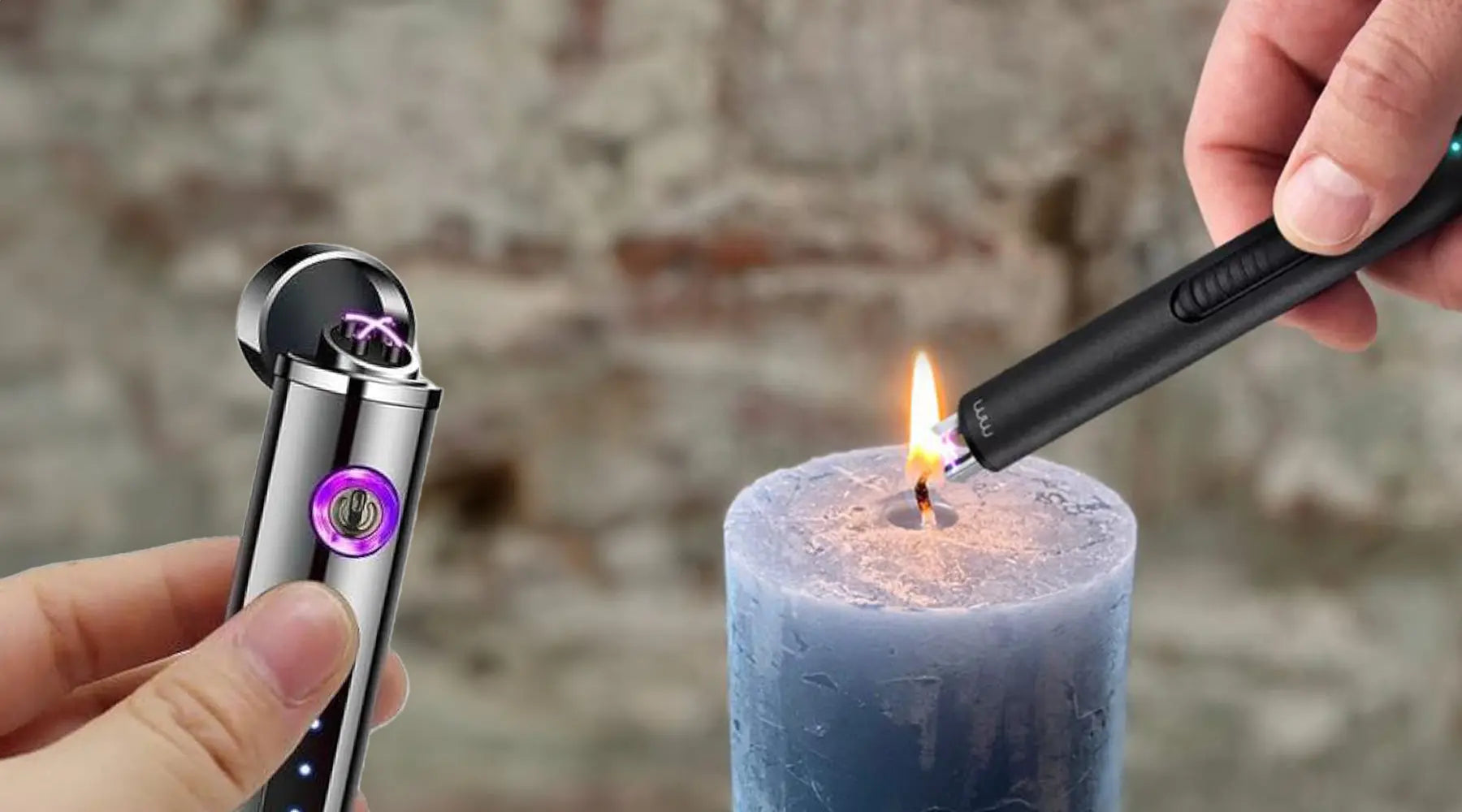
The short answer about the plasma lighter
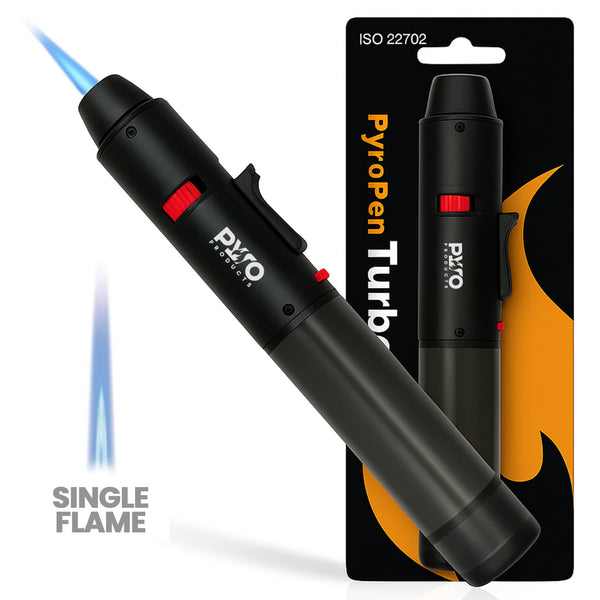
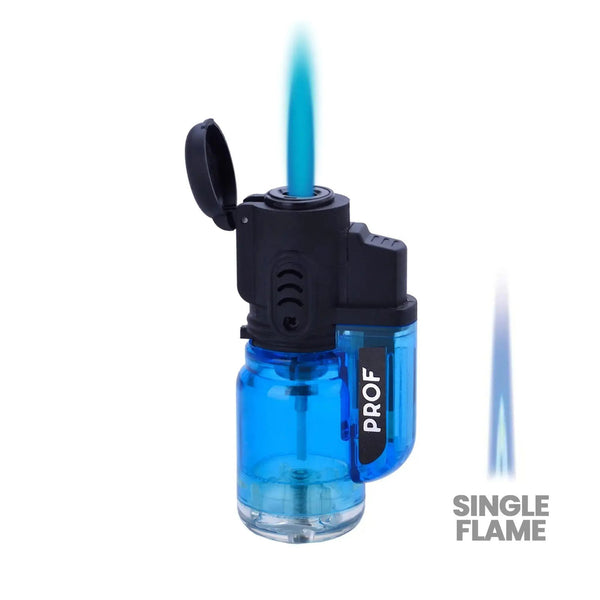
A plasma lighter makes no flame but an electric arc between two electrodes. It runs on a battery, charges via USB and doesn't blow out. For a cigarette in the wind that's pleasant. For fireworks it's no good: the arc is small, sits fixed between the pins and you have to get your hand right on top of it. That's why we don't sell plasma lighters. Our lighters collection has jet flame models that give a real flame and that you keep at a distance from the fuse. The PyroPen Turbo Lighter costs 9.95 euros and with its long neck is the most sensible choice as soon as there's a fuse involved. If you're after something small for daily use, the Prof Jet Lighter at 4.95 euros is more than enough.
How does a plasma lighter work?
An electric arc instead of a flame
A plasma lighter has two or four electrodes inside. Press the button and an arc jumps between those pins. High voltage ionises the air in between, so that blue-purple streak isn't a flame but conductive gas. There's no butane involved, no tank, and no flint that wears out. The heat sits in a strip of at most one and a half centimetres, right between the contacts and nowhere else.
Why an electric plasma lighter doesn't blow out
An ordinary flame needs oxygen, and that you can blow away. An arc doesn't: it stays on for as long as there's voltage. That's why electric plasma lighters are almost always sold as windproof. That's true in itself. But windproof isn't the same as usable outdoors. In our overview of the best storm lighters you'll see that a jet flame gets further in the same wind conditions, simply because it has reach as well as resistance.
Where the arc falls short
Reach is exactly the problem. An arc of one and a half centimetres means the object you're lighting has to fit inside it. A cigarette works. A candle with a recessed wick already gets tricky. A wood stove, a barbecue or a fuse don't stand a chance. You can't aim the arc, extend it, or angle it downward without your fingers ending up in the hot zone. Anyone who's tried that a few times puts the thing away and reaches for gas again.
Plasma lighter and fireworks: why it doesn't work
Fuses need a flame you can aim
Visco fuse has a coated outer layer that has to burn through before the powder inside catches. That requires a short, hot flame held against the fuse for a second or two, one that won't blow out. An arc can deliver that heat, but only if the fuse lies right through it. In practice, fuses bend away, lie flat on the ground, or point upward at an angle. Then you simply can't reach it.
Your hand shouldn't be above the charge
More importantly, there's the distance. With a plasma lighter, your knuckles end up almost right on the fuse, because the arc sits in the device itself. That's exactly the position you want to avoid with fireworks. A long lighter keeps your hand tens of centimetres away from the point where it starts burning, and that matters the moment a fuse catches faster than expected.
What does work
For fuses, go for a jet flame with length. The PyroPen Turbo Lighter has a long neck and a concentrated flame that stays lit even in a crosswind. Want more heat at once, for example for thicker fuse or a firelighter block? The Champ High Quattro Lighter gives you four jet flames side by side and has a lock button so you don't have to keep pressing while you aim.
What you need
We deliberately picked two lighters instead of a whole row. The first for outdoor work and fuses, the second for everyday use. If you mainly light fireworks, candles in the garden or a firelighter in the stove, you want length and go for the long version. If you're after something for your coat pocket that can take a knock, the small model is enough. The Prof Jet Lighter scores 5.0 out of 7 reviews from 7 ratings with us. If you want something compact with a stronger flame, the Atomic Jet Lighter at 9.95 euros is a good middle ground; it's shorter than the PyroPen Turbo Lighter but gives the same concentrated jet flame.
Is a plasma lighter dangerous?
You feel the arc too late
The arc is hot and it's silent. In daylight you can barely see it. With a flame, you pull your hand back because of the heat you already feel from ten centimetres away. With plasma, you feel almost nothing until you're in it, and then you've got a burn straight away. It's not a dramatic danger, but it is a different kind of danger than people are used to.
The battery is the real concern
The cheaper models contain a small lithium cell with little protection electronics, housed in a metal casing with a USB port. Leave a lighter like that on a warm windowsill or in a car in the sun, and you're taking a risk that a gas lighter with a pressure valve simply doesn't have. A refillable gas lighter from our refillable lighters range will at most leak a bit of gas when warm and is otherwise unbothered.
In your pocket and while travelling
A plasma lighter can switch on unintentionally in a trouser pocket if something presses against the button; better models therefore have a lock. If you take it travelling, keep in mind that air travel rules for batteries differ from those for gas. We've looked into what is and isn't allowed in the article about taking a lighter on a plane.
Buying a plasma lighter at Action or Blokker: what to look for
What you get for your money
The plasma lighters you see in household chain stores are almost all the same import with a different logo on them. The casing feels heavy, which inspires confidence, but the weight is in the metal, not the technology. Pay close attention to the locking mechanism, the quality of the USB port, and whether there's a brand name on it that's worth anything if the thing stops charging after three months.
Charging or refilling
A plasma lighter needs a cable and therefore a power socket. A gas lighter needs a canister, and that canister lasts a long time. A bottle of lighter gas refills dozens of times and costs next to nothing per refill. That's the practical difference: with gas, empty means ten seconds of refilling; with plasma, it means an hour of waiting.
Lifespan and maintenance
The electrodes of a plasma lighter get dirty over time, causing the arc to weaken or disappear altogether. You can clean them with a cotton bud, but you can't replace them. With a jet flame, at most you replace the gas and adjust the flame if it's too high or too low. The Prof Jet Lighter has an adjustment screw for this and a flap that protects the burner from lint in your pocket.
Frequently asked questions
A lighter that uses high voltage to create an electric arc between two or four pins. The air between them becomes conductive and hot. There's no gas and no flint, just a rechargeable battery with a USB port. You light something by holding it through the arc.
Not extremely, but in a different way than a gas lighter. The arc barely radiates heat, so you only notice it's hot when you touch it. The main point to watch is the lithium battery: don't leave it in the sun or in a hot car.
No. The arc is about one and a half centimetres long and sits fixed between the electrodes, so you have to hold your hand right above the wick. It's also difficult to light a bent or lying wick with it. For fireworks, choose a long jet flame lighter such as the PyroPen Turbo Lighter.
Those shops do indeed sell them, usually as a gadget by the till. We don't stock them because they fall short for our kind of use. If you're after a lighter that can handle wind and that you can actually aim, a refillable jet flame lighter is the way to go.
Usually somewhere between one hundred and three hundred ignitions, depending on how long you hold the button. Most models switch off automatically after about seven seconds to save the battery. Charging takes about an hour and can only be done with a power socket.
No, it doesn't contain any fuel. You charge it via USB, and that's the only option. Once the battery wears out, the device is done for. With a gas lighter, you refill it with a can of lighter gas and it lasts for years.
Our conclusion on the plasma lighter
The plasma lighter is a neat invention with a clear place: lighting a cigarette on a windy terrace, without gas and without a spark. Beyond that, it quickly hits its limits. No range, no direction, a battery you have to charge, and electrodes you can't replace. For wicks, candles, stoves and anything further away than one and a half centimetres, you need a real flame you can direct. That's why we sell jet flame lighters and no plasma lighters.
Want to see what does suit your needs? Take a look at our lighters or refillable lighters.
Related articles
 Lighters
Which lighter is easiest for older people or arthritis?
 Lighters
Jet flame lighter or soft flame: what is the difference?
 Lighters
Lighter not working anymore? Find the cause
Want more articles like this?
New tips, product comparisons and exclusive offers straight to your inbox.